EPCOT · former Future World
Horizons: EPCOT's Visions of Everyday Life in the Future
The history of EPCOT's Horizons pavilion, its future communities, guest-selected endings, General Electric sponsorship and replacement by Mission: SPACE.
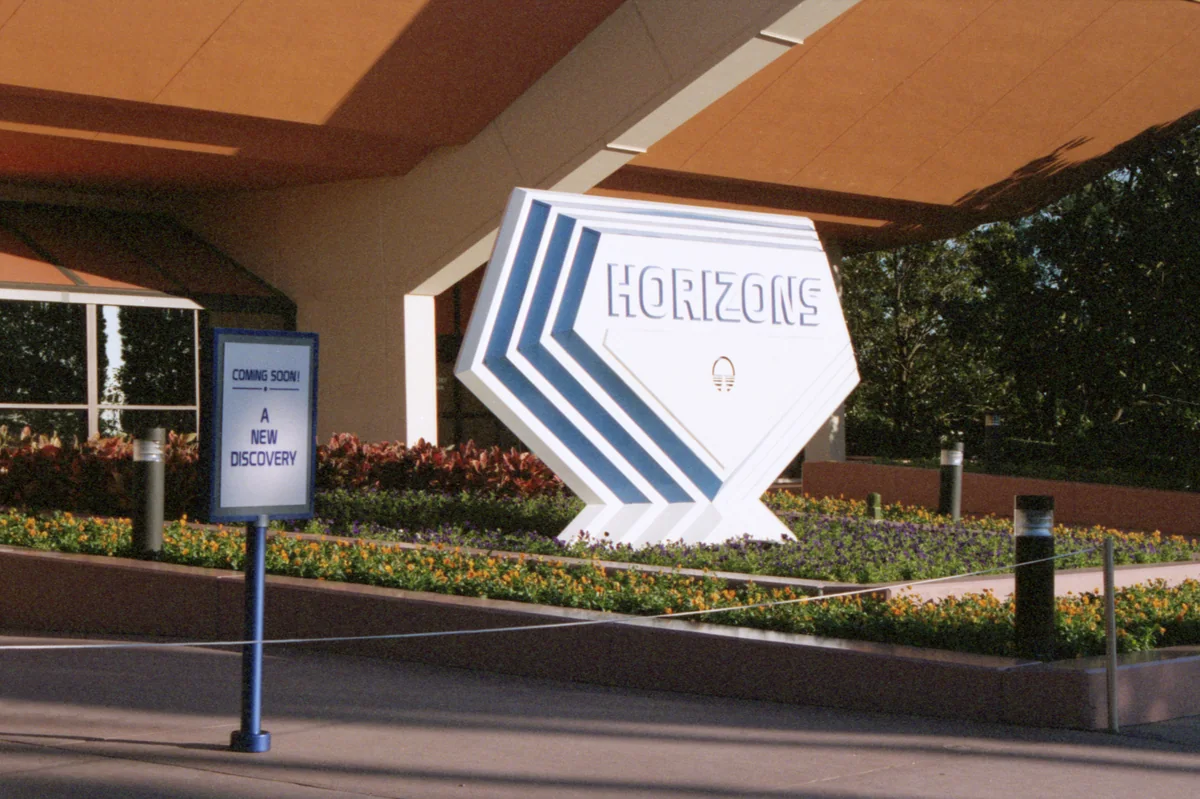
_1.jpg)
Photo provenance & reuse
Wikimedia Commons filename: Horizons (Epcot) 1.
January 1999. Original photographer's Flickr page says Taken on January 10, 1999; Commons summary says January 9, the closure date mentioned in the Flickr description. Use month precision rather than resolving the one-day conflict silently. Digital scan/EXIF dates in 2021 and Commons upload are not the photograph date.
Original source record · Checked description revision
_1.jpg&oldid=878825186)
Changes: Proportional mechanical resizing to the recorded widths without upscaling; no additional cropping, retouching, color adjustment, restoration, or generative edits. Re-encoded as WebP with Sharp, quality 84, effort 5. EXIF metadata is omitted from responsive copies; creator, source, license and modification notices are retained in this ledger and must accompany display.
No additional copyright notice was supplied in the inspected file-level description or targeted original metadata fields. The named creator and selected license must be credited.
Credit the creator and supplied title; link to source and Creative Commons Attribution 2.0; preserve supplied notices and identify modifications. The selected license allows commercial reuse and adaptation of the licensed photograph with its conditions; it does not require ShareAlike and does not imply endorsement.
Documented photographer-license and contextual historical editorial-display review only. Not independent proof of photographer identity or authority, Disney authorization, a merchandise clearance, or a clearance of separate depicted artwork, trademarks, privacy or publicity rights.
At a glance
- Place
- EPCOT · former Future World
- Subject
- Ride
- Current state
- Permanently closed (as of 2026-09-08)
Horizons opened at EPCOT on October 1, 1983, exactly a year after the park. General Electric sponsored it until September 30, 1993; Disney records its final closure as January 9, 1999. Its subject was not simply space travel or a new machine. It asked what everyday life might look like when people could build communities in deserts, beneath the sea and beyond Earth. Disney’s historical reference establishes those dates and the attraction’s central premise.
Designing a future pavilion
The name was itself part of the development process. Preserved proposal lists show the project moving through Century 3 and FutureProbe, with Great Expectations among the alternatives, before Horizons was selected. These were working identities, not separately operating EPCOT attractions. The surviving documents make a useful distinction between the history of an idea and the history of the finished ride. D23’s naming study reproduces the archival material.
Disney’s longer retrospective describes a project developed around GE’s broad interests rather than an already fixed pavilion theme. Earlier science-and-invention proposals included a rotating theater; the finished experience instead became a journey through different environments. Its family-centered future had a relationship to Carousel of Progress without being another installation of that show. D23’s development history traces that change in direction.
A future people could inhabit
The ride first considered older visions of tomorrow, including Jules Verne’s, before introducing imagined future living. That contrast gave the subject a built-in caution: yesterday’s confident forecasts could look whimsical to a later audience. Scents, staged scenery and an Omnimax film presentation then made tomorrow something visitors could experience rather than merely read about. Disney’s attraction summary identifies these techniques.
The later communities had names and domestic routines: Mesa Verde was the desert setting, Sea Castle the undersea world, and Brava Centauri a space colony. Birthday preparations, children and family conversations made technology part of ordinary life. In that sense, the memorable achievement was not only showing ambitious places to live; it was making them look like places where familiar human relationships would continue. The documented scenes support that reading without requiring us to treat their predictions as scientific promises. D23’s illustrated retrospective
An ending chosen aboard the ride
Near the conclusion, passengers used buttons to select their return experience. Disney identifies this as its first attraction to let guests choose how the experience ended. The route choice translated the pavilion’s theme into a small act of participation: after looking at possible futures, riders selected one. It did not mean that each vehicle could roam freely through the building, or that every earlier scene changed with the vote. Disney’s reference entry
The art beyond the vehicles
The exit originally included Robert McCall’s The Prologue and The Promise. McCall Studios records a 19-by-60-foot canvas commissioned for Horizons, developed in Arizona and painted at Disney’s Burbank studios with help from Louise McCall. Completed in March 1983, it included members of the artist’s own family. That personal detail echoed the ride’s larger concern: a technological future still populated by recognizable people. The studio’s account documents the artwork; it does not establish a present public display location. McCall Studios
Closure and replacement
Horizons’ final years were not uninterrupted. Disney’s retrospective records a closure in late 1994, a return in December 1995 and the final 1999 closure. Mission: SPACE subsequently occupied its site in 2003. Those documented transitions should not be turned into an unsupported explanation involving a sinkhole, structural failure or a single corporate decision. The historical record here establishes what changed, not every reason behind it. D23’s chronology
For the successor’s distinct history and operating experience, continue to Mission: SPACE. Horizons remains a former attraction, not an earlier name for that simulator.
Documented dates
Sources & evidence notes
Links in the text lead to the supporting records. Notes below explain what each source establishes; an official retrospective is distinguished from a contemporary announcement or firsthand account.
- Horizons — D23. primary reference; accessed 2026-09-08.
Opening, closure, GE sponsorship, three future environments, Omnimax and guest-selected ending.
Return to the article ↑ - A Pavilion By Any Other Name — D23. primary document; accessed 2026-09-08.
Reproduces pavilion naming documents, including Century 3, FutureProbe and Great Expectations.
Return to the article ↑ - Reaching For New Horizons — D23. secondary history; accessed 2026-09-08.
Disney-hosted illustrated development history; domestic scenes, community names, temporary closure/reopening and 2003 successor. Causal explanations beyond this are excluded.
Return to the article ↑ - The Prologue and The Promise — McCall Studios. primary reference; accessed 2026-09-08.
Artist studio account: commission, dimensions, working locations, Louise participation and March 1983 completion; no current location given.
Return to the article ↑
About this entry
Published · Updated . Evidence review: .
Written and source-checked with AI assistance, including a separate automated review. This is not a claim of firsthand experience or professional human fact-checking. Corrections policy & change log.
Continue exploring
-
EPCOT / Ride
Mission: SPACE
The source-backed history of Mission: SPACE, its 2003 opening and dedication, NASA consultation, Orange and Green missions, and 2017 update.
Operating · multiple versions -
EPCOT / Ride
Journey Into Imagination
How EPCOT's Imagination pavilion and its 1983 ride differ, what changed in 1999 and 2002, and what Disney has announced about Dreamfinder's return.
Operating · multiple versions -
Magic Kingdom / Ride
20,000 Leagues Under the Sea
The Florida Nautilus attraction, its 1971 opening and 1994 closure, and the long transformation of its Fantasyland lagoon.
Permanently closed -
Magic Kingdom / Ride
Astro Orbiter
The Florida Star Jets opened in 1974 and became Astro Orbiter in 1994. Separate the versions, the similarly named overseas rides and unverified statistics.
Operating · multiple versions