Magic Kingdom · Fantasyland
20,000 Leagues Under the Sea: Magic Kingdom's Lost Submarine Lagoon
The Florida Nautilus attraction, its 1971 opening and 1994 closure, and the long transformation of its Fantasyland lagoon.
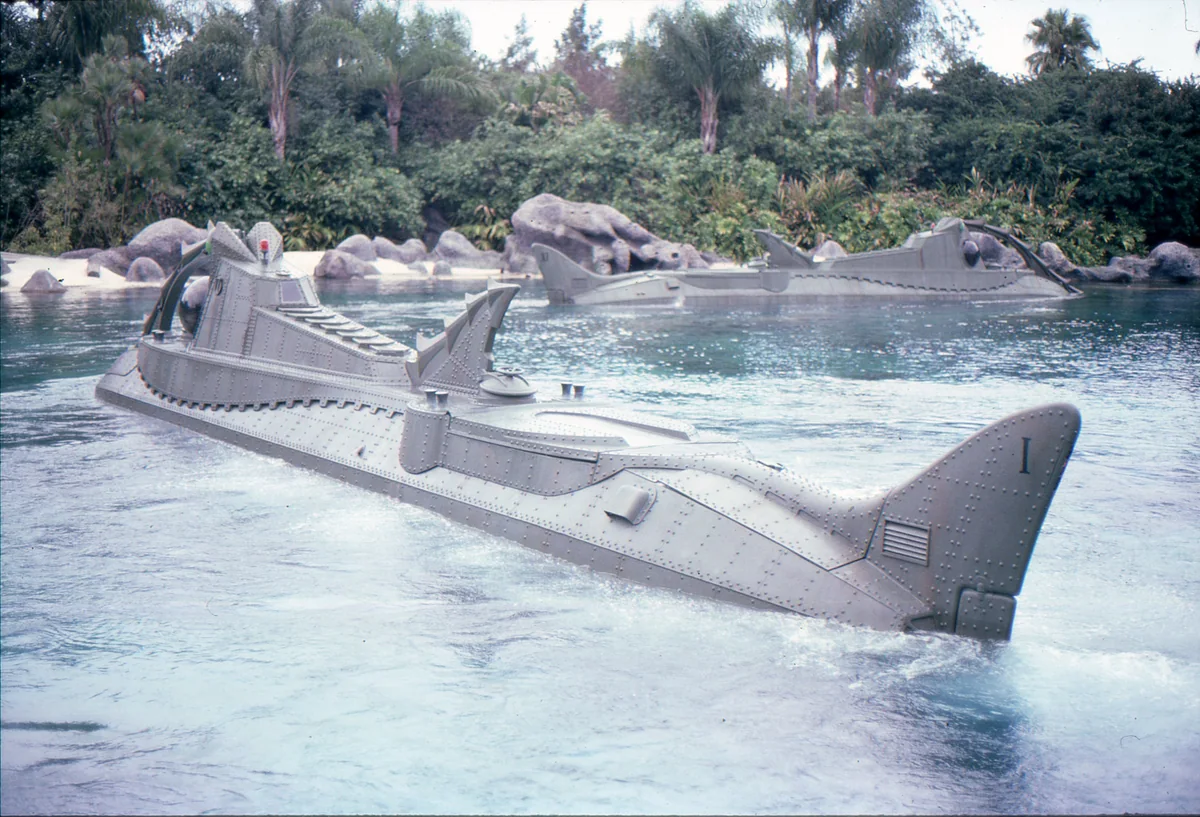

Photo provenance & reuse
Commons description dates the scene roughly to spring 1979. The January 5, 2014 date in digital metadata is associated with the scan, not a photograph of an operating attraction in 2014. Commons calls this a scan of the creator's original photograph.
Original source record · Checked description revision

Changes: Proportional mechanical resizing to the recorded widths without upscaling; no additional cropping, retouching, color adjustment, restoration, or generative edits. Re-encoded as WebP with Sharp, quality 84, effort 5. EXIF metadata is omitted from responsive copies; creator, source, license and modification notices are retained in this ledger and must accompany display.
No additional copyright notice was supplied in the inspected file-level description or targeted original metadata fields. The named creator and selected license must be credited.
Credit the creator and supplied title; link to source and Creative Commons Attribution-Share Alike 3.0; preserve supplied notices and identify modifications, including prior edits. These responsive copies retain the selected license. Distribute any copyrightable adaptations under the same or a compatible ShareAlike license, without added legal or technological restrictions. Attribution must not imply endorsement.
Documented photographer-license and contextual historical editorial-display review only. Not independent proof of photographer identity or authority, Disney authorization, a merchandise clearance, or a clearance of separate depicted artwork, trademarks, privacy or publicity rights.
At a glance
- Place
- Magic Kingdom · Fantasyland
- Subject
- Ride
- Current state
- Permanently closed (as of 2026-09-08)
- Names in the record
- 20,000 Leagues Under the Sea: Submarine Voyage
20,000 Leagues Under the Sea was a submarine-themed attraction in Magic Kingdom’s Fantasyland. Disney A–Z records its opening on October 14, 1971, and closure on September 5, 1994. Its twelve vessels were styled after Captain Nemo’s Nautilus, giving Florida a conspicuously different fleet from Disneyland’s modern-looking submarines. Disney A–Z: the Florida attraction.
The attraction is gone, but identifying exactly what disappeared requires separating three histories: the fictional submarine, the theme-park ride, and the changing landscape that followed. A photograph of an idle lagoon documents a later stage than an operating voyage, even when the boats look familiar.
A Nautilus for Fantasyland
The source of the design was Disney’s film 20,000 Leagues Under the Sea, released on December 23, 1954, from Jules Verne’s story. Disney’s film reference credits Harper Goff with the Nautilus design. The vessel was a fictional machine associated with Captain Nemo, not a reproduction of a contemporary naval submarine. Disney A–Z: the film.
That distinction helps explain its Fantasyland identity. The ride brought a recognizable imaginary vessel into the park’s landscape. Disney explicitly contrasts that choice with the more contemporary submarine appearance used in California. The shared idea of an undersea attraction did not require the two parks to share the same visual story. Florida design comparison.
Descriptions of the movie’s special effects should not be mistaken for documentation of the attraction. A film-production account of a giant mechanical squid, for example, does not establish how a later park scene worked or how many people maintained it. The film supplies narrative context; the ride needs its own evidence.
The lagoon as a public landmark
Werner Weiss’s Yesterland history includes a Florida photograph dated 1983, separately captioned from the many Disneyland images on the page. It shows why the attraction was more than an interior show: the visible water and distinctive boat belonged to the surrounding Fantasyland view. That photograph is useful evidence of appearance at a particular time, not a plan of every underwater effect. Yesterland’s Florida section.
This also sets a limit on scene reconstructions. Most of that source describes California’s Submarine Voyage. Its full sequence of scenery cannot simply be transferred to Florida because both attractions featured boats and underwater imagery. Resort-specific evidence matters as much as a familiar attraction name.
Closure was not demolition
Disney places closure in 1994 but demolition in summer 2004. The decade between those events is central to the attraction’s afterlife. A ride can stop carrying guests while its site remains recognizable; the date of physical removal should not overwrite the date of closure. Disney A–Z chronology.
The consulted reference does not establish a single financial or technical reason for the decision. Claims that it was the park’s most expensive attraction, or that an exact staffing or accessibility problem caused its closure, need supporting records before they can be presented as fact.
What followed
Disney records a Florida Ariel’s Grotto character-greeting location opening in Fantasyland in October 1996. That was a different experience, not a reopened submarine ride, and should not be confused with the California restaurant of the same name. Ariel’s Grotto reference.
Yesterland places Pooh’s Playful Spot on part of the old site from 2005 to 2010 and connects the former lagoon area with the later Seven Dwarfs Mine Train. These successive uses are more accurately described as a changing district than as one attraction replacing every square foot of another. Site history.
Finally, Disneyland’s 1955–1966 20,000 Leagues movie-set walkthrough was a separate attraction altogether. Keeping that exhibit, California’s submarine ride and Florida’s Nautilus fleet distinct prevents a familiar title from merging several different histories. Disney A–Z: film-set exhibit.


Photo provenance & reuse
Source description gives 1994 only. The January 8, 2022 current file timestamp is a later border-crop revision, not the photograph date.
Original source record · Checked description revision

Changes: Current Commons source revision has a roughly 1% border crop by Sebastian Wallroth, January 8, 2022. That prior crop is retained and credited; no additional crop was made. Proportional mechanical resizing to the recorded widths without upscaling; no additional cropping, retouching, color adjustment, restoration, or generative edits. Re-encoded as WebP with Sharp, quality 84, effort 5. EXIF metadata is omitted from responsive copies; creator, source, license and modification notices are retained in this ledger and must accompany display.
Public-domain dedication applies to the photographer's work; it does not dedicate Disney's separate intellectual property.
The creator's public-domain dedication covers this photograph, with the source page's any-purpose fallback where dedication is not legally possible. Creator, source and prior-crop credit are retained voluntarily for provenance. It is not CC0 and does not clear Disney art, trademarks, publicity rights or merchandising.
Documented photographer-license and contextual historical editorial-display review only. Not independent proof of photographer identity or authority, Disney authorization, a merchandise clearance, or a clearance of separate depicted artwork, trademarks, privacy or publicity rights.
Documented dates
Florida attraction opened
opened · D23 / Disney A–ZClosure recorded by Disney A–Z
closed · D23 / Disney A–ZDemolition in summer
demolished · D23 / Disney A–Z
Sources & evidence notes
Links in the text lead to the supporting records. Notes below explain what each source establishes; an official retrospective is distinguished from a contemporary announcement or firsthand account.
- 20,000 Leagues Under the Sea — D23 / Disney A–Z. primary reference; accessed 2026-09-08.
Florida entry establishes dates, 12 Nautilus-style vessels, summer 2004 demolition.
Return to the article ↑ - 20,000 Leagues Under the Sea (film) — D23 / Disney A–Z. primary reference; accessed 2026-09-08.
1954 film, Verne adaptation, Harper Goff design; film production details are not ride mechanisms.
Return to the article ↑ - Submarine Voyage — Werner Weiss / Yesterland. secondary history; accessed 2026-09-08.
Updated August 1, 2025; final Florida paragraph and 1983 WDW photograph; California narrative kept distinct.
Return to the article ↑ - Ariel's Grotto — D23 / Disney A–Z. primary reference; accessed 2026-09-08.
Florida character-greeting area opened October 1996; separate from California restaurant.
Return to the article ↑ - 20,000 Leagues Under the Sea Exhibit — D23 / Disney A–Z. primary reference; accessed 2026-09-08.
Disneyland movie-set exhibit 1955–1966, not Florida ride.
Return to the article ↑
About this entry
Published · Updated . Evidence review: .
Written and source-checked with AI assistance, including a separate automated review. This is not a claim of firsthand experience or professional human fact-checking. Corrections policy & change log.
Continue exploring
-
Magic Kingdom / Park & land
Magic Kingdom
How Magic Kingdom emerged from the Florida Project, opened in 1971 and developed its own architecture, transportation and changing attraction history.
Operating · multiple versions -
Magic Kingdom / Ride
Mr. Toad's Wild Ride — Florida
Florida's Mr. Toad ride ran from 1971 to 1998. Explore its two-track identity, film source, Winnie the Pooh replacement and separate Disneyland survivor.
Permanently closed -
Magic Kingdom / Ride
Astro Orbiter
The Florida Star Jets opened in 1974 and became Astro Orbiter in 1994. Separate the versions, the similarly named overseas rides and unverified statistics.
Operating · multiple versions -
Magic Kingdom / Ride
Fire Mountain
What published sources support about Magic Kingdom's unbuilt Fire Mountain, its Atlantis connection, and the separate Mount Fuji proposal at EPCOT.
Planned, never built