Walt Disney World · early resort-hotel master plan
Disney's Unbuilt Asian, Persian, and Venetian Resorts
The early Walt Disney World hotel plans, their different themes and timelines, and what contemporary documents actually say about the resorts that never opened.
At a glance
- Place
- Walt Disney World · early resort-hotel master plan
- Subject
- Resort
- Current state
- Planned, never built (as of 2026-09-08)
- Names in the record
- Persian Resort · Venetian Resort
Early Walt Disney World maps can look like evidence of a lost destination: familiar hotels share the landscape with an Asian Resort, a Persian Resort, and a Venetian Resort. But these three properties were proposals, not closed hotels. Disney’s Archives-assisted map history confirms their public announcement in 1969 and that none materialized.
They are best understood as part of a broader plan for a vacation destination. The hotel ideas were not simply extra room blocks. Their different visual identities would have made travel around the resort part of the entertainment, with lodging, recreation, and transportation belonging to the same designed landscape.
Five themes did not mean five opening-day hotels
A surviving Disney press release named Contemporary, Polynesian, Asian, Venetian, and Persian hotel themes. It described a development period extending through the first five years of operation, tied to public demand. The document also presented monorails, boats, and land vehicles as an integrated transportation network. See PDF page 12 of the original press material.
That wording is an important corrective to an attractive but misleading story: Disney did not describe all five hotels as simultaneously ready for opening day. A reader comparing the prospective map with a later photograph must separate the destination’s master plan from its first operating phase.
The Asian Resort: a plan that persisted
The Asian hotel was described in a 1969 preview as primarily Thai in decor. A later, firmer milestone appears in Disney’s 1972 annual report: the company expected to begin architectural work on a 500-room Asian Hotel and planned construction and opening in 1974.
That target was not met, but its existence demonstrates that this proposal still figured in published corporate planning after Walt Disney World began operating. Its later history should not automatically be assigned to the Persian and Venetian projects, for which the inspected sources do not establish the same 1974 timetable. The dedicated Asian Resort history follows those changes in more detail.
The Persian Resort: a palace-like composition
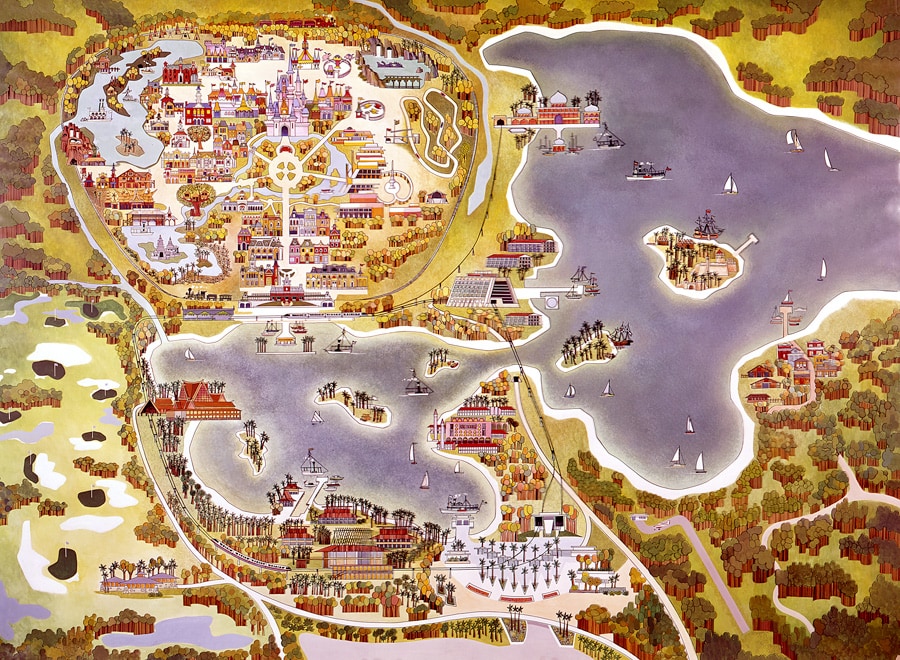
The proposal occupied a different body of water from the Asian and Venetian hotels. In Disney’s early resort illustration, its domed complex stands on Bay Lake’s western shoreline, north of the Contemporary. Jack Spence’s illustrated examination of the preview material also describes that north-of-Contemporary, east-of-Magic-Kingdom location. The placement is a proposed setting, not the footprint of a hotel that once operated. Disney’s original illustrated map, Spence’s map discussion.
Elizabeth Whitney’s 1969 newspaper preview, reproduced by ImagiNERDing, described the Persian proposal as a palace-like hotel arranged around a prominent blue dome, with balconies and a projected 500 rooms. This is a contemporary description available through a modern transcription, not evidence of an operating building.
The dome gave the proposal an immediately recognizable focal point. In the context of a destination built around water and movement, a distinctive outline could advertise a hotel’s identity from a distance. That is an interpretation of the described design, not proof of a particular completed facade, restaurant menu, or guest-room plan.
The Venetian Resort: waterways as the setting
The Venetian site lay along the eastern side of Seven Seas Lagoon, between the Transportation and Ticket Center and the Contemporary. Disney’s illustration shows the proposed waterfront complex on that stretch of the monorail circuit; Spence’s account explicitly identifies the two neighboring landmarks. Keeping it on the lagoon, and the Persian proposal on Bay Lake, prevents two distinct hotel sites from being merged into one vague “Magic Kingdom area” location. Early Disney map, Location and reproduced concept artwork.
The same reproduced preview described a 500-room Venetian hotel drawing on St. Mark’s Square and Venice-like waterways. Its identity therefore depended on a relationship between architecture and water, rather than merely applying Italian decoration to an ordinary hotel block.
This Venetian proposal belongs to the early group. It should not be collapsed into the later Mediterranean hotel studies: the University of New Mexico separately catalogs a Mediterranean project model associated with Antoine Predock and dated 1988–1991. The archival item record provides an independent marker of that later design history.
What replaced the plans?
Disney identifies the Grand Floridian as the hotel eventually built at the Asian Resort site. That is a connection between locations, not a renaming of an already completed Asian hotel. The 2013 map article’s observations about undeveloped sites should likewise be read as observations from 2013, not a current land-use survey.
Why all three hotels failed to open is less securely documented than their identities. The inspected announcement, annual report, and archival descriptions do not establish one common cancellation date or a single shared cause. Economic explanations, soil stories, and later changes of management need evidence tied to each specific project before becoming factual conclusions.
These resorts remain worth studying because they reveal the options considered for the original vacation landscape. Their historical value lies in the differences between those options and the resort that emerged, not in imagining that every drawing was a fully approved building awaiting construction.
Documented dates
Asian, Persian, and Venetian hotels announced
announced · Disney Parks Blog
Sources & evidence notes
Links in the text lead to the supporting records. Notes below explain what each source establishes; an official retrospective is distinguished from a contemporary announcement or firsthand account.
- Vintage Walt Disney World: Old Maps of Walt Disney World Resort — Disney Parks Blog. primary reference; accessed 2026-09-08.
Identifies all three unbuilt hotels, their 1969 announcement, and Grand Floridian's relationship to the Asian site. Land-use observations date to 2013.
Return to the article ↑ - Walt Disney World Unveils New Concept for Destination Vacation Resort — Walt Disney World; scan hosted by DisneyDocs. primary document; accessed 2026-09-08.
PDF page 12 visually verified: phased, demand-dependent hotel development and integrated transportation.
Return to the article ↑ - Walt Disney Productions Annual Report 1972 — Walt Disney Productions; Internet Archive copy. primary document; accessed 2026-09-08.
OCR paragraph establishes a 500-room Asian Hotel with a proposed 1974 timetable, not the same timetable for Persian and Venetian.
Return to the article ↑ - Disney World Preview 1969: A Look Before Opening — ImagiNERDing. secondary history; accessed 2026-09-08.
Reproduces a 1969 newspaper description of Thai, blue-domed Persian, and St. Mark's-inspired Venetian proposals; original newspaper not inspected.
Return to the article ↑ - Model for Mediterranean Hotel, Walt Disney World — University of New Mexico, Center for Southwest Research. primary document; accessed 2026-09-08.
Public item metadata names Antoine Predock and a 1988–1991 Mediterranean project; metadata read via the repository's public singleitem endpoint.
Return to the article ↑ - Early Walt Disney World resort illustration — Disney, republished by Disney Parks Blog. primary document; accessed 2026-09-09.
Original linked image downloaded and visually inspected. The domed Persian complex lies on Bay Lake's western shore beyond the Contemporary, while the Venetian complex occupies the eastern Seven Seas Lagoon shoreline between Contemporary and the Transportation and Ticket Center. Compass-language corroborated by Spence's explicit location text; schematic proposal, not a surveyed as-built plan.
Return to the article ↑ - Hotels That Never Were at Walt Disney World — AllEars / Jack Spence. secondary history; accessed 2026-09-09.
July 17, 2009 illustrated examination of preview material: Venetian paragraph explicitly places it between TTC and Contemporary; Persian paragraph places it north of Contemporary and east of Magic Kingdom on Bay Lake. Other cancellation stories and proposed opening dates are not adopted.
Return to the article ↑
About this entry
Published · Updated . Evidence review: .
Written and source-checked with AI assistance, including a separate automated review. This is not a claim of firsthand experience or professional human fact-checking. Corrections policy & change log.
Continue exploring
-
Resort-wide / Resort
Disney's Asian Resort
Trace Disney's Asian Resort from the 1969 plans to a proposed 1974 opening, and distinguish its Thai-inspired design from the later Grand Floridian.
Planned, never built -
Resort-wide / Resort
Disney's Mediterranean Resort
Separate Alan Lapidus's Mediterranean Village recollections from Antoine Predock's later hotel model, and distinguish both from the original Venetian Resort.
Planned, never built -
EPCOT / Park & land
EPCOT
How Walt Disney's 1966 city proposal became EPCOT Center in 1982, with phased pavilion openings, lost attractions and the park's later neighborhood changes.
Operating · multiple versions -
Resort-wide / Resort
Disney's All-Star Music and All-Star Movies Resorts
Opening dates, phased construction and architectural history of Disney's All-Star Music and All-Star Movies Resorts, with their different themed sections.
Operating · multiple versions