Walt Disney World · Bay Lake, beside Fort Wilderness
River Country: Walt Disney World's First Water Park
River Country opened beside Fort Wilderness in 1976 and closed in 2001. Explore its swimming-hole design, documented attractions, and Bay Lake legacy.
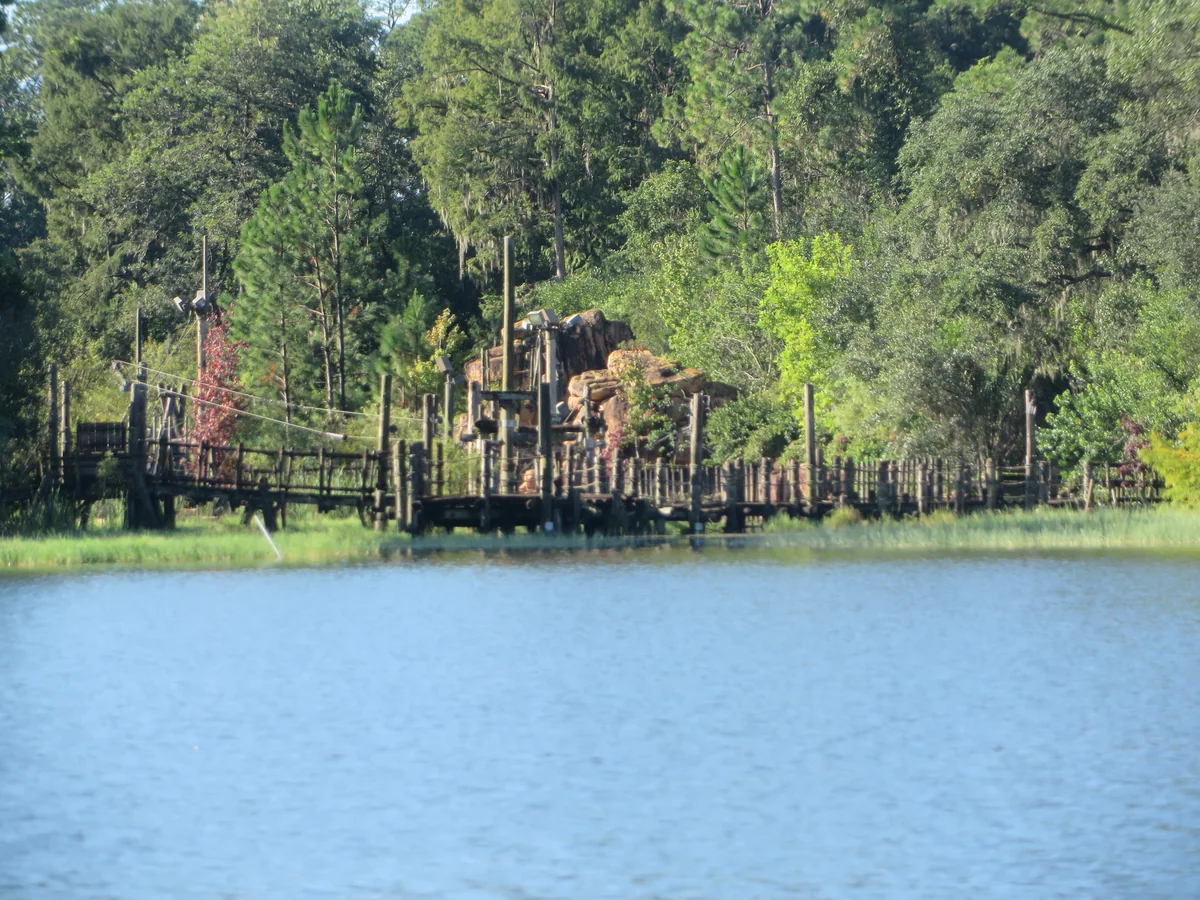

Photo provenance & reuse
File description and camera metadata agree on August 13, 2017; upload later that day is separately recorded.
Original source record · Checked description revision

Changes: Proportional mechanical resizing to the recorded widths without upscaling; no additional cropping, retouching, color adjustment, restoration, or generative edits. Re-encoded as WebP with Sharp, quality 84, effort 5. EXIF metadata is omitted from responsive copies; creator, source, license and modification notices are retained in this ledger and must accompany display.
No additional copyright notice was supplied in the inspected file-level description or targeted original metadata fields. The named creator and selected license must be credited.
Credit the creator and supplied title; link to source and Creative Commons Attribution-Share Alike 4.0; preserve supplied notices and identify modifications, including prior edits. These responsive copies retain the selected license. Distribute any copyrightable adaptations under the same or a compatible ShareAlike license, without added legal or technological restrictions. Attribution must not imply endorsement.
Documented photographer-license and contextual historical editorial-display review only. Not independent proof of photographer identity or authority, Disney authorization, a merchandise clearance, or a clearance of separate depicted artwork, trademarks, privacy or publicity rights.
At a glance
- Place
- Walt Disney World · Bay Lake, beside Fort Wilderness
- Subject
- Recreation
- Current state
- Permanently closed (as of 2026-09-08)
- Names in the record
- Disney's River Country
River Country was Walt Disney World’s first water park, opening beside Fort Wilderness on June 20, 1976. Its central idea was a rustic swimming hole on the edge of Bay Lake, with slides and rockwork that extended the campground’s outdoor atmosphere. It closed in 2001, after roughly twenty-five years of operation. The exact final operating day remains a point requiring more precise contemporary documentation. Disney’s River Country reference, Walt Disney Archives retrospective.
A swimming hole built for a vacation resort
Disney’s reference describes designers creating an old-fashioned swimming place rather than reproducing a formal pool complex. Artificial miniature mountains supplied the height that Florida’s terrain did not. Bay Cove, the main swimming area, was connected with Bay Lake. These features made the landscape part of the attraction’s identity, rather than simply a backdrop around conventional slides. Disney’s River Country reference.
The neighboring campground is essential context. The Archives’ retrospective reproduces a 1976 Fort Wilderness map showing River Country within that larger recreation setting. Seen that way, it belongs to the resort’s history of things to do beyond the theme parks: an afternoon in the water could be a destination in its own right, without a ride through a theatrical show building. Walt Disney Archives.
What guests experienced
The park combined different kinds of water recreation. One particularly well-documented example is Slippery Slide Falls. The Archives describes two short chutes ending in a drop into Upstream Plunge, a clear-water pool. That is a different setting from the lake-connected Bay Cove. Describing the entire park as either an ordinary swimming pool or undifferentiated lake swimming loses this distinction. Archives attraction description, Bay Cove reference.
River Country’s appeal can be understood through that contrast: a deliberately informal-looking landscape still offered designed, named experiences. Its rustic presentation was an artistic choice, not proof that the environment lacked planning. The relationship between the rockwork, slides, swimming spaces, and campground is more useful to its history than the later shorthand of an “abandoned Disney park.”
Opening celebrations and later influence
The 1976 opening formed part of Walt Disney World’s Bicentennial summer. The Archives identifies Susan Ford’s participation and preserves event material, including special admission bracelets and commemorative coins used for the celebration. Such objects document how the opening was presented at the time, while the map places the new park in its physical surroundings. Walt Disney Archives opening material.
Disney’s A–Z account connects River Country’s popularity with the later decision to build Typhoon Lagoon and Blizzard Beach. Archivist Dave Smith subsequently explained that River Country and Discovery Island closed after larger, more elaborate attractions elsewhere at the resort superseded them. This is an attributed retrospective explanation; it is not a contemporary financial breakdown or evidence for every proposed closure theory. Disney’s water-park reference, Dave Smith’s Archives answer.
Why the closure date needs care
Disney’s A–Z entry gives September 1, 2001; its Archives retrospective says September 2001. This site’s earlier account supplied a different exact day without adequate independent support. Until a dated operating calendar or contemporary notice resolves the final public day, this history uses 2001 as the closure date rather than presenting a disputed day as certain. A–Z, Archives retrospective.
Closure, a later decision not to reopen, and demolition are different events. Likewise, explaining a closure through disease, regulation, or particular maintenance costs requires evidence specific to that decision. Those claims should not be inferred simply from the park’s relationship with lake water.
The later Bay Lake landscape
As of September 2026, Disney’s Lakeshore Lodge is a future resort project along Bay Lake. Disney’s August 27 announcement schedules its opening for July 1, 2027, with 967 rooms. The same rolling project update describes a planned historical tribute along its recreation-area path. These are announced future features, not a report that the resort is already open. Disney’s dated Lakeshore Lodge update.
River Country’s historical identity remains distinct from that development: a small-scale themed water park helped establish a much larger recreation category at Walt Disney World. Its surviving documentary record—maps, event objects, photographs, and attraction descriptions—offers a firmer way to recover that experience than unsupported stories about its abandonment.
Correction, September 2026: Removed unsupported medical/engineering explanations and exact closure/demolition assertions, corrected inconsistent duration comparisons, and distinguished a future resort opening from completed events.
Documented dates
River Country opened
opened · D23; Walt Disney Archives / D23River Country closed; exact final day unresolved
closed · D23; Walt Disney Archives / D23
Sources & evidence notes
Links in the text lead to the supporting records. Notes below explain what each source establishes; an official retrospective is distinguished from a contemporary announcement or firsthand account.
- River Country — D23. primary reference; accessed 2026-09-08.
Opening, Fort Wilderness/Bay Cove concept and influence; exact closure September 1 conflicts with earlier site's November date.
Return to the article ↑ - Revisiting River Country — Walt Disney Archives / D23. primary reference; accessed 2026-09-08.
Opening celebrations, 1976 map, Slippery Slide Falls/Upstream Plunge and September 2001 closure.
Return to the article ↑ - Bayley, Sacramento, California — D23. primary reference; accessed 2026-09-08.
Attributes closure of River Country/Discovery Island to being superseded by larger attractions; no itemized costs or medical causation.
Return to the article ↑ - Letters from Lakeshore: Updates on Disney World's Newest Resort — Disney Parks Blog. official announcement; accessed 2026-09-08.
Aug. 27 section schedules July 1 2027 opening and 967 rooms; June 17 section describes future historical plaque. Rolling page, time-bound.
Return to the article ↑
About this entry
Published · Updated . Evidence review: .
Written and source-checked with AI assistance, including a separate automated review. This is not a claim of firsthand experience or professional human fact-checking. Corrections policy & change log.
Continue exploring
-
Resort-wide / Recreation
Discovery Island — Bay Lake
Discovery Island opened on Bay Lake as Treasure Island in 1974 and closed in 1999. Its history spans the pre-Disney landscape, wildlife exhibits, and changing names.
Permanently closed -
Resort-wide / Recreation
Eagle Pines
Eagle Pines was Disney's Pete Dye-designed course, open from 1992 to 2007. Its history is distinct from Osprey Ridge, the course later updated as Tranquilo.
Permanently closed -
Resort-wide / Recreation
DisneyQuest Orlando
DisneyQuest brought virtual rides and hands-on games to Downtown Disney in 1998. Its Orlando history, experiences, expansion plans, and July 2017 closure.
Permanently closed -
Resort-wide / Park & land
Pleasure Island
Pleasure Island's 1989 opening, entertainment and admission changes, the 2008 club closures, the unbuilt Hyperion Wharf plan and The Landing.
Permanently closed