Disney Springs · Lake Buena Vista waterfront
The Empress Lilly: Three Restaurants and a Riverboat's Changing Identity
The Empress Lilly's 1977 opening, Lillian Disney dedication, original restaurants, 1995 closure and later Fulton’s Crab House and Paddlefish eras.
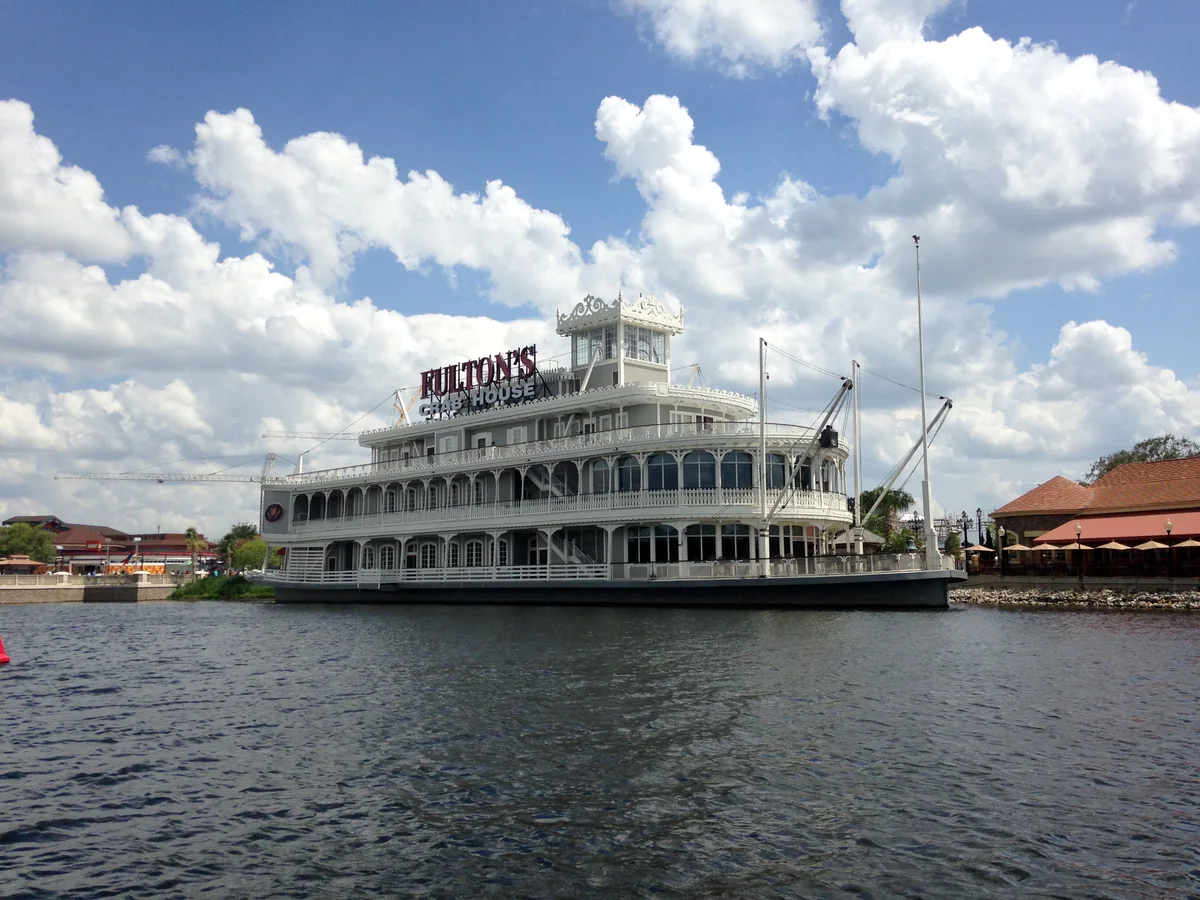

Photo provenance & reuse
Commons description and camera metadata agree on August 6, 2015. English Wikipedia upload in January 2016 and Commons transfer in February 2016 are separate from photo date.
Original source record · Checked description revision

Changes: Proportional mechanical resizing to the recorded widths without upscaling; no additional cropping, retouching, color adjustment, restoration, or generative edits. Re-encoded as WebP with Sharp, quality 84, effort 5. EXIF metadata is omitted from responsive copies; creator, source, license and modification notices are retained in this ledger and must accompany display.
No additional copyright notice was supplied in the inspected file-level description or targeted original metadata fields. The named creator and selected license must be credited.
Credit the creator and supplied title; link to source and Creative Commons Attribution-Share Alike 3.0; preserve supplied notices and identify modifications, including prior edits. These responsive copies retain the selected license. Distribute any copyrightable adaptations under the same or a compatible ShareAlike license, without added legal or technological restrictions. Attribution must not imply endorsement.
Documented photographer-license and contextual historical editorial-display review only. Not independent proof of photographer identity or authority, Disney authorization, a merchandise clearance, or a clearance of separate depicted artwork, trademarks, privacy or publicity rights.
At a glance
- Place
- Disney Springs · Lake Buena Vista waterfront
- Subject
- Dining
- Current state
- Permanently closed (as of 2026-09-08)
The Empress Lilly opened on May 1, 1977, as a riverboat dining complex at Walt Disney World. It was named for Walt Disney’s wife, Lillian, known as Lilly. The original Disney operation closed on April 22, 1995; the same waterfront structure later housed Fulton’s Crab House and Paddlefish. These were successive restaurant identities, not three simultaneous names for the original dining rooms. Disney’s Empress Lilly history
A dedication with a personal connection
Lillian attended the dedication with five of her and Walt’s grandchildren. Disney’s 2021 retrospective includes a photograph of her christening the riverboat with Donn Tatum. It supplies a direct link between the venue’s name and the family member it honored, rather than requiring a guessed explanation based on riverboat tradition. Disney’s illustrated dedication account
The boat-shaped setting also distinguished the experience from a conventional shopping-village restaurant. Guests went aboard a moored landmark on Lake Buena Vista; the destination was dining, not a scheduled excursion around the lake. Disney still describes its successor in terms of an anchored steamboat. The documented identity is clear even without repeating an unverified account of precisely how its foundation was poured. Current waterfront description
Three restaurants, not one menu
Disney identifies the original restaurants as the Fisherman’s Deck, the Steerman’s Quarters and the Empress Room. The Empress Room occupied a distinctive place in the resort’s dining history: Disney’s reference describes it as the property’s leading elegant-dining experience before Victoria and Albert’s opened. That is a historical characterization, not a present-day ranking or a claim that every room aboard offered the same level of service. Disney’s dining-room record
The complex also included a jazz lounge, according to Disney’s later account. This combination explains why “we ate on the Empress Lilly” can conceal very different recollections. A family might remember one dining room, a formal evening another, or music separate from a meal. A full menu history would need dated menus from each venue rather than combining every remembered dish into one fictional restaurant menu. Disney’s 2021 retrospective
A recipe as a surviving record
One documented culinary connection is the Empress Lilly au gratin potatoes recipe republished by Disney for its fiftieth-anniversary cookbook. The post identifies the restaurant provenance and notes that the recipe was adapted from a larger kitchen quantity. That qualification is useful: a home version preserves a connection to the old dining experience, but should not be represented as a verbatim commercial kitchen formula with an identical result. Disney’s recipe and publication notes
The district changed around it
The boat predates Pleasure Island. Disney’s record explains that it was originally associated with the shopping village and became part of the newer area when Pleasure Island was built immediately beside it in 1989. The change was in the surrounding district, not a relocation of the original restaurants to a newly built island boat. Disney’s location chronology
After the 1995 closure, Fulton’s Crab House opened on March 10, 1996. Disney records Chicago-based Levy Restaurants as the operator and describes a 700-seat restaurant on the former Empress Lilly. This establishes a new operator and dining identity without attributing the original closure to an unsupported financial strategy. Disney’s Fulton’s record
Paddlefish and physical continuity
Paddlefish opened on February 4, 2017, according to Disney’s riverboat chronology. Its current official listing presents a seafood-and-steak restaurant with waterfront and roof-deck seating, a substantially different program from the old collection of dining rooms. Historical succession and current Paddlefish listing
The useful continuity is the recognizable riverboat dining destination. It does not mean every original fitting, interior or exterior component survived each renovation. For the broader changing waterfront, see Pleasure Island.
Documented dates
Sources & evidence notes
Links in the text lead to the supporting records. Notes below explain what each source establishes; an official retrospective is distinguished from a contemporary announcement or firsthand account.
- Empress Lilly — D23. primary reference; accessed 2026-09-08.
May 1, 1977 opening; namesake Lillian Disney; three dining rooms; 1989 Pleasure Island adjacency; April 22, 1995 Disney-operation closure; Fulton and Paddlefish successors.
Return to the article ↑ - Cooking Up the Magic: Empress Lilly Au Gratin Potatoes — Disney Parks Blog. primary document; accessed 2026-09-08.
Lillian with five grandchildren; christening photograph caption names Donn Tatum; three restaurants and jazz lounge; adapted-recipe provenance, with no recipe reproduced.
Return to the article ↑ - Fulton's Crab House — D23. primary reference; accessed 2026-09-08.
Dedicated reference identifies Levy, 700 seats and March 10, 1996 opening.
Return to the article ↑ - Paddlefish — Walt Disney World. primary reference; accessed 2026-09-08.
Current waterfront steamboat restaurant at Lake Buena Vista; seafood, steaks and roof deck. No foundation-engineering claim.
Return to the article ↑
About this entry
Published · Updated . Evidence review: .
Written and source-checked with AI assistance, including a separate automated review. This is not a claim of firsthand experience or professional human fact-checking. Corrections policy & change log.
Continue exploring
-
Resort-wide / Park & land
Pleasure Island
Pleasure Island's 1989 opening, entertainment and admission changes, the 2008 club closures, the unbuilt Hyperion Wharf plan and The Landing.
Permanently closed -
Magic Kingdom / Dining
Adventureland Veranda
Adventureland Veranda opened in 1971 and ended regular restaurant service in 1994. Trace its tropical menu, architecture, and later Skipper Canteen reuse.
Permanently closed -
Magic Kingdom / Dining
Gurgi's Munchies and Crunchies
The documented history of Gurgi's Fantasyland counter-service restaurant, its Black Cauldron namesake and its change to Lumiere's Kitchen.
Permanently closed